The last few weeks saw another upheaval in the tech markets. The release of Kimi K3 seemed to shake confidence in the idea that OpenAI and Anthropic had a lock on the best models for the foreseeable future. Kimi K3, and GLM 5.2 before it, come close on some AI benchmarks and cost less to use. Their makers also release the weights, so large-scale users with powerful hardware can host them locally and pay nothing to any AI developer. Or users can pay a third-party inference provider to host an open-weight model at a low price.
All that raises the question of how Anthropic or OpenAI can justify their massive near-trillion-dollar valuations. Can they pull off an IPO now? Even if the U.S. were to ban the use of Chinese models, would that protect the leading companies? There’s a whole world out there outside the USA after all. And what if the U.S. labs take part in a safety slowdown? Does that put them at risk of getting overtaken?
Free, open-weight, innovative Chinese AI appears to be catching up to U.S. model capability, which seems like a bad sign for prospective Anthropic and OpenAI shareholders. It’s also a bad sign for current investors in most parts of the AI economy. Huge investments go into developing and refining AI models, but the Chinese makers do it cheaper, which would seem to show those investments represent overspending. The Chinese models typically cost less to use too. It looks like the U.S. models are doomed to fall behind.
The actual situation isn’t so simple. Whether Chinese AI constitutes a threat to U.S. AI dominance hinges on how AI model development works, something we’re all still figuring out. The idea that the Chinese models (Qwen, GLM, Kimi K, DeepSeek) could overtake Claude, ChatGPT and Gemini in capability soon is probably incorrect. Probably. It could be a trillion-dollar question.
Really there are two questions:
- How likely are the Chinese models to overtake the leading U.S. models in capability? I’ll explore this below.
- How likely are the Chinese models to take away significant amounts of business? I don’t know, but I have some thoughts.
If having the leading model matters most, U.S. companies should be safe for a while. But if access to the next best model costs 25% as much, and 90% of customers don’t actually need the leading models most of the time, U.S. AI is in financial trouble. It’s not that they can’t figure out how to serve up AI at Chinese prices (outside of subsidies), it’s that selling tokens (inference) at cost squeezes their ability to demonstrate they have a viable business.
Competing for Users
Businesswise, competitive pricing is certainly a vulnerability. Once six-month-old models perform well enough for 99% of users, it may not matter to them that they don’t use the latest and greatest when good enough costs 25% as much. A lot more happens in six months of AI development than it used to, and maybe the leading models will stay attractive to the most valuable customers. It’s too early to say.
Still, if Chinese models capture 75% of the usage by what is essentially dumping, they can cut the legs out from under OpenAI and Anthropic. Google is pretty safe since most of its value lies elsewhere.
The shift away from U.S. AI in favor of Chinese models is well underway. The share of tokens on OpenRouter from 2025 to mid-2026 went from 4.5% to 58%.
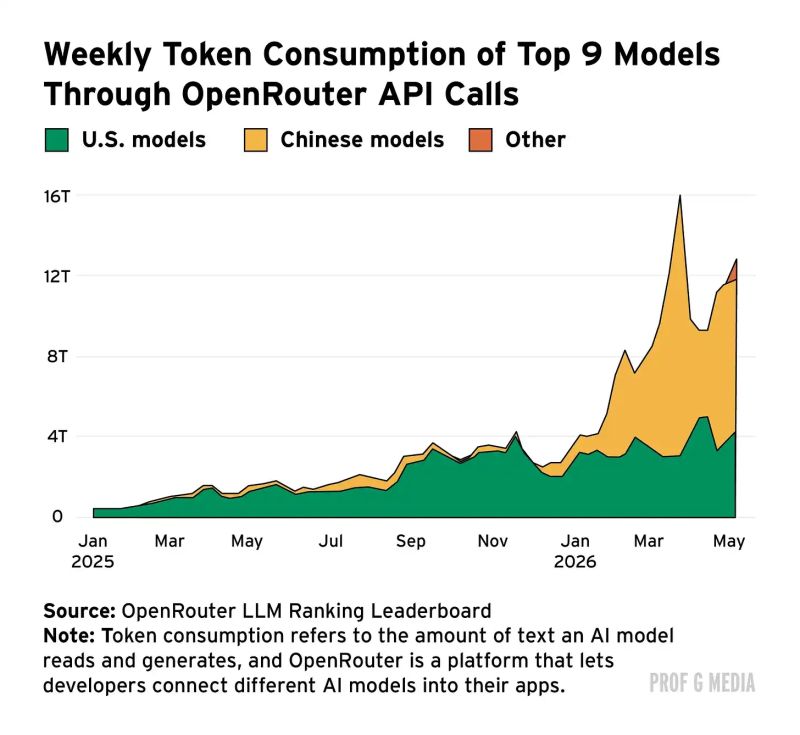
That’s not a full picture. It only shows what OpenRouter customers do, which doesn’t necessarily mirror the whole market, though it’s a dramatic trend. The situation is changing rapidly.
On the other hand, not all tokens are equal. Some models, including Kimi K3, are notably less efficient token users. It costs more tokens to accomplish a task on Kimi K3 than to do the equivalent task on Claude Fable 5.
On the third hand, every provider charges very different amounts for different model tokens. Claude’s Fable 5 is simultaneously the most expensive per token and the most efficient on tokens per task. To get a good measure you’d want to see tasks completed by model and token broker, which may never be available.
Inference and Model Training
Let’s clarify that two distinct costs are involved: first, model development (training), and second, serving the AI model to users (called inference). Chinese labs offer their models for low rates and seem to have developed those models more efficiently than the U.S. labs.
Anthropic says the inference part of their business is profitable (if you could somehow separate it financially from future model development). U.S. companies ought to be able to stay competitive on inference. It’s just a matter of keeping up with the latest techniques, and special-purpose inference hardware will probably be available roughly equally. [1] Competing on model development cost is a more complicated question, which I go into next.
To understand whether Chinese AI really poses an existential threat to the U.S. AI business, you have to know how they have developed their models so far, and how model development actually works generally. Just looking at Kimi K3’s current capability next to Anthropic’s Fable 5 and viewing it as a race is misleading. How they got to where they are is apples and oranges.
How to Build an AI Model
Quick outline:
Pre-training
Pre-training consists of ingesting vast amounts of high quality language: messaging, books, articles, FAQs, scientific papers and everything else. The technical challenge here is to consume the material efficiently at scale, distributing the work.
This is where language gets encoded into tokens, relationships between words get formed, and the model learns to predict what likely comes next. At this stage the model will complete both sides of a conversation, or try to continue whatever else you feed it.
Post-training
1. Supervised fine-tuning
The model is taught to distinguish between the two sides of a conversation. New tokens are added to represent the sides, and the model can learn to complete only its own. This takes less compute than the pre-training phase.
You feed the model curated high quality examples, either synthetic or human generated. At this stage you’re tuning the model to learn desirable behavior patterns for reasoning, conversation and problem solving.
Success at this stage is known as achieving a “cold start.” Now you can throw as much reinforcement learning at the model as you like, and it can actually make effective use of the additional training.
2. Reinforcement learning
This is where the model is trained to reach goals. It can learn from example scenarios or from human feedback. To start with, you feed the unformed model thousands or millions of examples and problem solving scenarios.
In scenarios like coding challenges, where the solution can be checked automatically (the solution compiles and produces a correct output), the training process records many attempts by the model to solve the challenges. These are called “trajectories.” They are incredibly useful for teaching coding and general computer use.
You grade the results with another model or a human, or with pass/fail if there’s a specifically correct answer. The model learns by scoring well, but the scoring system has to be designed carefully so the models don’t cheat to obtain a good score.
Trajectories now are pretty complex as the models get more and more capable. Running enough challenging ones to advance the model’s abilities costs a lot. Thousands will produce no successes. To improve a model in a reasonable timeframe, thousands of instances have to run at once, which takes a lot of the best hardware. Rather than simple questions, some trajectories now resemble full software projects.
On top of all this, you want to make sure it interacts well with human users, so you do RLHF (reinforcement learning with human feedback). This will take a while and thousands of human trainers.
Distillation
Borrow successful examples of problem solving from already trained models. You don’t need to spend time calibrating the rewards and running hundreds of thousands of failed trajectories.
Instead of most supervised fine-tuning, you can use an already trained model to provide example responses to your model. In other words, you don’t need as much human feedback. It’s already embedded in the fully trained model that required human feedback.
The reinforcement learning phase could be shortened if you can work from the most effective trajectories.
Distilling vs. Original Training
There’s strong evidence most of the Chinese models were distilled from U.S. models, mainly Claude and ChatGPT. An overwhelming portion of online public discussion around that claim centers on moral or legal angles, but those don’t really matter. Debating whether Anthropic or OpenAI or Moonshot AI (Kimi K) is more in the wrong is a distraction, deliberately so I think. [2] What matters is (1) whether it’s true (it is), and (2) once you have an accurate understanding of the situation, what the technical and financial implications are.
During distillation you’re extracting information created during the laborious post-training phase. Think of the outputs of an AI like a function: if you get enough examples of inputs and outputs you can work out an approximation of that function, at least for inputs you care about. You capture hundreds of thousands of x = f_chatgpt(y) for a good variety of y.
By skipping the expensive post-training, especially the human feedback part, you can release models much faster and cheaper than a developer that has to do all the original work. The RLHF stage takes a lot of people a lot of time, and it’s a crucial step that the original developer can’t rush much. Staffing up super fast is harder than provisioning a bunch of servers for a week to distill that same RLHF from another model. A developer distilling a model downstream of the original can purchase temporary compute to quickly extract the value the post-training added.
Part of the motivation for this approach had to be that the most advanced Nvidia GPUs were banned for export to China, so the labs had to make do with less powerful processors. That put even more pressure on DeepSeek to not only skip RLHF but also use less compute overall. Lacking the most powerful GPUs, Chinese developers had to innovate hard to squeeze out as much training and inference as they could with what they had.
Just how much time and money distillation saves is an empirical question, but we could roughly estimate up to 50% of the cost, and more than that of the total time to finish building their model. Getting access to vast amounts of interactions with the leading models is interesting but could fairly be called cheating.
The legal or moral high ground doesn’t matter much. If Chinese AI companies have “cheated” to catch up, there’s not much U.S. companies or the government can do to stop them. If the U.S. “unfairly” blocks the use of Chinese models domestically over national security concerns rather than IP or trade secret theft claims, it won’t stop the Chinese AI companies either. Since China already blocks Gemini, ChatGPT and Claude, the U.S. labs don’t stand to lose that business in retaliation. They’re already blocked. What China can do is keep releasing open-weight models. If U.S. closed-model AI gets too expensive, users in the U.S. and around the world can use their own hardware or go through third-party hosts of the open-weight models.
How They Do It
While Claude is banned in China, there are resellers or “relays” that Chinese users can pay, which collect subscriptions and pool them for their users. To make even more money, the relays can copy the transcripts and sell them to the Chinese labs to use in post-training. Here’s a recent example. Operators at an AI lab can of course also use these relays to submit training scripts on purpose.
The scheme is alleged to be fueled with credit card and gift card theft, which saves money and makes the number of users appear higher and geographically random. Anthropic claimed Alibaba (Qwen) alone created around 25,000 fraudulent accounts to make 28 million interactions to train from.
The other major Chinese labs, Moonshot, MiniMax and DeepSeek, are also using this approach.
Leading AI Labs Set the Pace
Although distilling allows you to skip a lot of slow and expensive process, you’re never adding your own original post-training ideas, only distilling an approximation of the source AI. Someone actually has to pay for the original post-training to get fundamentally new capabilities on top of a base model.
So the fact that several Chinese models approach the newest Claude or ChatGPT capability may not present much of a threat to a monopoly on the SOTA (state of the art). If skipping original post-training is a major contributor to the Chinese AI development speed, they aren’t going to surpass the U.S. SOTA models.
The question remains whether most customers require that extra edge, but in national security terms the U.S. could still expect to stay in the lead. Furthermore, if the Chinese labs mainly “draft” off the leading U.S. labs, in principle a deliberate slowdown on development would slow down the Chinese AI labs too.
Cold Start to Recursive Self-Improvement
Even when distillation provides a cold start, it’s not enough to sustain future development. What actually matters is whether the Chinese models can achieve recursive self-improvement.
Recursive self-improvement simply means the ability for an AI system (it would have to be more than a mere model) to get powerful enough to improve itself without the bootstrap phase provided by humans. This would probably look like AI providing substantial help in developing a successor model, and that successor becoming even more capable assisting in the development of its own successor, and so on.
To go from close behind to ahead of the frontier models would require either an independent full-scale post-training operation or effective recursive self-improvement.
If recursive self-improvement really is a thing in the near term, even blocking Chinese AI makers from U.S. model output, somehow, won’t do much for long.
Summing Up
Not only could cheaper models take a lot of the market. If they reach the critical threshold where they can do recursive self-improvement, they can achieve parity with the U.S. SOTA models.
-
Alternative specialized hardware for LLM inference is being developed. It’s expensive and limited in quantity currently, but there’s no reason to think it will only be available in one country. Cerebras has very fast processors, up to 15 times faster. This hardware favors high throughput and low latency. It’s currently expensive compared to generic GPUs, but it has a quality all its own. GPUs were the general purpose LLM chips, useful for training and inference. However, training can tolerate large latency and favors large batch jobs, where inference is just the opposite. Google has developed its TPU (Tensor Processing Unit) for inference, and Amazon has its own custom hardware as well. It’s a competitive space. More in this AI Inference Hardware Guide.
-
There are hundreds upon hundreds of comments in social media and forums of the form “Anthropic stole thousands of books and information in general to make their model, so what’s wrong with Chinese AI stealing from them?” It’s a deceptive, nihilistic tactic, since obviously two things can be wrong at once. Plus, Anthropic and OpenAI have actually settled with and compensated authors a lot, and now have policies that they at least plausibly can claim stick to “fair use.” It’s certainly not all settled law yet though. Still, the attacks count on readers being uninformed.
The relentless attacks on Anthropic (now that they have eclipsed OpenAI) are an obvious campaign to demoralize Anthropic users and investors. That’s it. I don’t know if OpenAI or Chinese companies or the Chinese government orchestrate it, but you can see the aim clearly enough. Spend a little time looking at who posts the comments and how similar they are and it’s clear.
The main things the campaign does are (1) change the subject away from whether the Chinese labs deserve sanctions and consequences (“What about Anthropic’s stealing?”) and (2) give the impression everyone is fleeing U.S. AI.
By flooding social media with this sentiment, they steer discussions away from the actually interesting questions: whether Chinese AI developers are taking distillation shortcuts, and why that matters economically and technically. There’s plenty of ill will against the big AI companies and it’s easy to harness it to derail discussion.
The question of whether it’s okay to read the whole internet and most books and create an art, music and text generation machine that overwhelms all the output of actual creative humans is something else, and to be clear I think it’s bad.
There are also a lot of comments praising the services that provide access to Chinese models, and praising open-weight policies. They say the prices for GLM 5.2 or Kimi K3 are way more affordable than Claude or ChatGPT. That may be so (it’s complicated), but what they don’t point out is that these prices are probably subsidized even more heavily than ChatGPT or Claude pricing. It can’t go on forever. That’s fine, but the tone of the comments implies the U.S. providers are ripping off their users and you’re a chump to pay full U.S. prices.
Whatever else you think of the U.S. AI companies, clearly it isn’t the case that they are extracting huge profits from their users. The prices are barely enough to pay for inference directly, and not enough to cover all its externalities. They’re burning cash. Certainly not enough to underwrite future model development, which is still mostly done with private investment. For the Chinese models that are open weight, the services selling inference don’t have to pay for any of the model development. And for the developers selling their service directly, the original development didn’t cost nearly as much if they distilled the U.S. models.